
Sweepstakes casinos are the only legal model in the United States that lets you play casino-style slots for free and redeem real cash prizes — all without a traditional gambling license. If you've been searching for a free SC casino real money opportunity, you've likely noticed the landscape has shifted dramatically. What was once an obscure corner of online gaming is now a $10 billion industry that outearns regulated iGaming, attracts over 55 million American players annually, and faces an unprecedented regulatory crackdown that has already shut the doors in six states.
The year 2026 marks a turning point. California's unanimous ban — 36-0 in the Senate, 79-0 in the Assembly — sent a clear signal that lawmakers across the political spectrum view dual-currency platforms as gambling in all but name. New York, Montana, Connecticut, New Jersey, and Nevada followed with their own legislative bans, collectively erasing roughly a quarter of the industry's domestic revenue. According to iGaming Business, sweepstakes casinos generated $10 billion in gross sales during 2024, making the stakes of these bans impossible to ignore.
This guide exists because the space is saturated with affiliate content that treats every platform like a five-star pick. That is not what you will find here. What follows is a data-driven analysis of free SC casinos — the market forces shaping them, the legal terrain constraining them, and the mechanics that determine whether your Sweeps Coins actually convert into dollars. We pull from Eilers & Krejcik Gaming research, AGA survey data, KPMG reports, and IRS documentation to give you something most guides skip: context backed by numbers.
The $10 Billion Sweepstakes Casino Market in Five Facts
- Sweepstakes casinos generated $10 billion in gross sales and $3.4 billion in net revenue during 2024, surpassing regulated iGaming for the first time — but six state bans in 2025 are projected to shrink revenue by 10 percent in 2026.
- Only 12 percent of users ever purchase Gold Coins; the remaining 88 percent play entirely free through daily logins, social media promotions, and mail-in AMoE requests.
- Sweeps Coins redeem at approximately 1 SC = $1 via bank transfer, PayPal, or crypto, with minimum thresholds ranging from $20 to $100 depending on the platform.
- Sweepstakes casinos operate legally in 40-plus states but are now banned in California, New York, Nevada, New Jersey, Connecticut, Montana, Washington, and Idaho, with Florida, Indiana, and Maine likely next.
- Ninety percent of users recognize these platforms as gambling, yet the industry remains largely unregulated — no mandatory RNG audits, no statewide self-exclusion registries, and zero state gaming taxes paid.
What Are Sweepstakes Casinos and Why They Hit $10 Billion
A sweepstakes casino is an online platform that offers casino-style games — slots, blackjack, roulette, poker — through a dual-currency system designed to sidestep the legal definition of gambling. The core argument is elegant in its simplicity: traditional gambling requires three elements — consideration (a payment), chance, and a prize. Remove one element and the activity no longer qualifies as gambling under most state statutes. Sweepstakes casinos remove consideration by offering free entry. As Magnus Boberg, founder of JustGamblers, explains: "Traditional gambling requires three elements: consideration (payment), chance, and prize. Sweepstakes sites do not require payment, so they bypass regulations that apply to traditional online gambling." The legal theory borrows directly from the promotional sweepstakes model that companies like McDonald's and Publishers Clearing House have used for decades.
In practice, that free-entry mechanism sits alongside a purchase system that looks remarkably like buying casino credits. Players buy packages of Gold Coins — a purely recreational virtual currency — and receive Sweeps Coins as a "free bonus" with each purchase. Only Sweeps Coins can be redeemed for cash prizes, and platforms also provide free Sweeps Coins through daily logins, social media giveaways, and mail-in requests known as Alternative Method of Entry. That last part is the legal linchpin: because you can always get Sweeps Coins without paying, the operator argues there is no purchase requirement, and therefore no consideration.
The distinction between this model and traditional online gambling may seem like semantic gymnastics, but it has been enormously profitable. According to a KPMG analysis of the emerging sweepstakes sector, the market grew at a compound annual growth rate of 60 to 70 percent between 2020 and 2024, with revenue climbing from $3.1 billion in 2022 to a projected $6.9 billion in 2025. That trajectory places sweepstakes casinos among the fastest-growing segments in the entire gaming industry — faster than sports betting, faster than regulated iGaming, and faster than traditional brick-and-mortar expansion.
The audience behind that growth is massive. Over 55 million Americans play sweepstakes-style games annually, according to Lineups.com, with platforms like WOW Vegas, McLuck, and High 5 Casino each attracting more than one million U.S. players. The appeal is straightforward: you can access these sites from most states (no need to live in New Jersey or Michigan), sign up in minutes, and start playing immediately. For the roughly 43 states without active iGaming legislation, sweepstakes casinos are functionally the only option for online casino play — and players know it.
The supply side has responded to that demand with an arms race of new brands. According to Casino.org, more than 25 new sweepstakes brands launched in 2025 alone, pushing the total number of active platforms in the United States past 140. The proliferation is partly organic — low barriers to entry, no state-by-state licensing — and partly strategic. When your customer acquisition cost runs between $50 and $100 per user and the total addressable market spans 200-plus million adults, the math invites competition regardless of the regulatory headwinds blowing through state capitols.
Understanding this market context matters because it shapes everything downstream. The bans aren't random; they're a response to an industry that grew too large to ignore. The platform choices available to you depend on which operators survived the contraction. And the value of the free Sweeps Coins sitting in your account is directly tied to whether the dual-currency model will hold up under the next round of legislative scrutiny. None of these questions have simple answers, which is precisely why a data-driven analysis of free SC casinos requires more than a list of promo codes.
Gold Coins vs Sweeps Coins — The Engine Behind Free SC Play
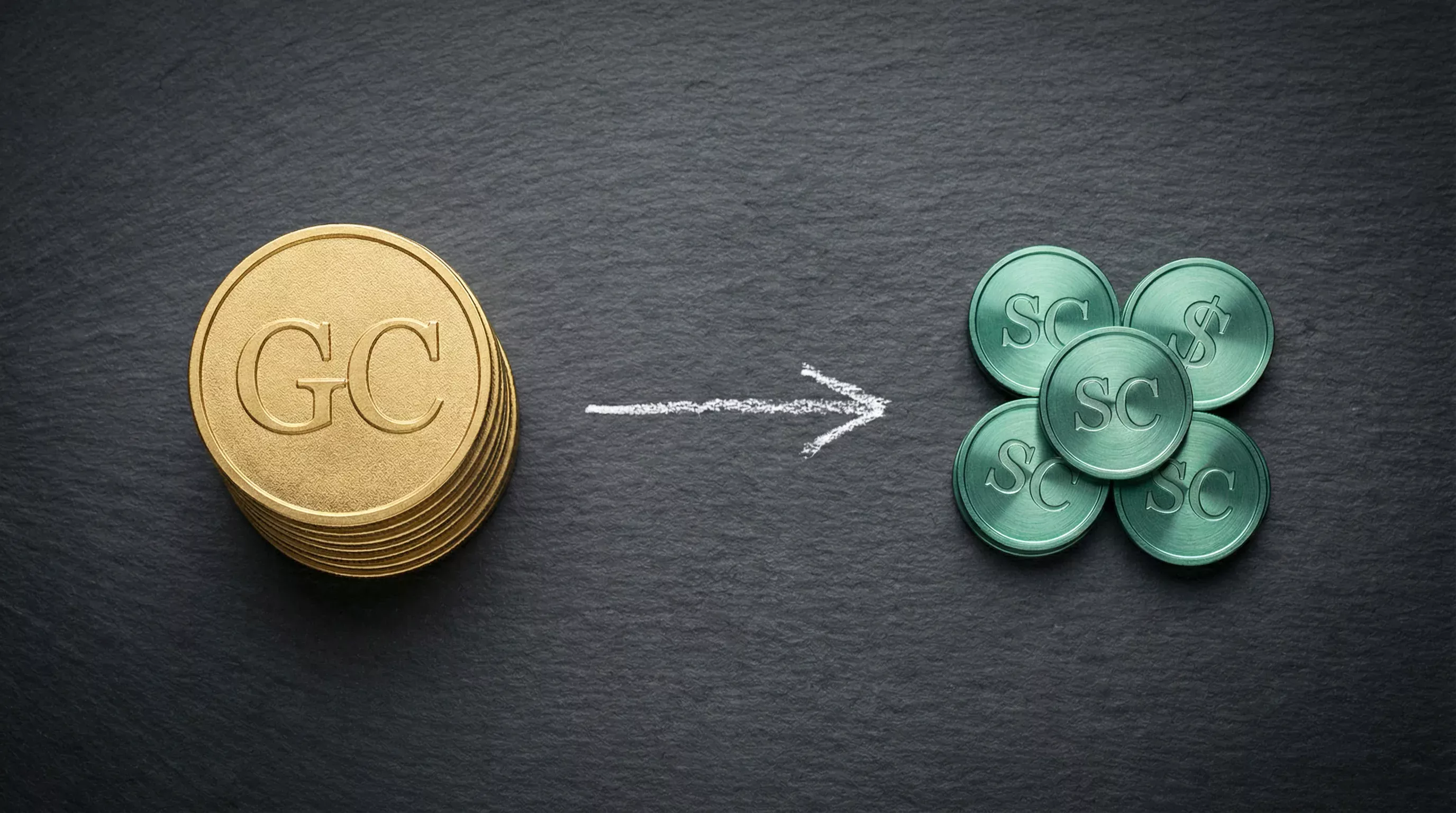
Gold Coins (GC) — a virtual currency used for entertainment play only. Gold Coins have no cash value and cannot be redeemed. They are purchased in packages, typically ranging from $4.99 to $99.99, and function like arcade tokens.
Sweeps Coins (SC) — a promotional currency that can be redeemed for real cash prizes, usually at a rate of 1 SC = $1. Sweeps Coins are never directly purchased; they are received as a free bonus with Gold Coin packages or obtained through no-purchase methods like daily logins and mail-in requests.
The dual-currency model is the architectural foundation of every sweepstakes casino, and misunderstanding it is the fastest way to lose track of your money. Here is how the system actually works. You visit a platform — say, Chumba Casino or WOW Vegas — and create a free account. Upon registration, most platforms credit your account with a small amount of both Gold Coins and Sweeps Coins. That initial free balance lets you explore the game library without spending a cent.
When you decide to buy, you are technically purchasing Gold Coins. A typical package might cost $9.99 and include 2,000,000 Gold Coins plus 30 free Sweeps Coins. The Gold Coins are for recreational play on "Gold Coin mode" versions of the games. The Sweeps Coins, legally framed as a promotional bonus, are what carry actual value. You play Sweeps Coin games, accumulate more SC through wins, meet the platform's wagering requirement (usually a 1x playthrough), and then request a redemption — the sweepstakes-casino equivalent of a withdrawal.
The financial reality of this system is less symmetrical than it appears. According to RG.org, the sweepstakes industry posted approximately $3.4 billion in net gaming revenue during 2024, after players had collectively spent between $8.5 and $10.6 billion on Gold Coin packages. The gap between gross spending and net revenue represents prize payouts — but it also reflects the industry's effective margin. When you spend $10 on a Gold Coin package, roughly $3 to $3.50 ends up as operator revenue after all prizes are paid out across the player base.
Here is where the economics get interesting — and potentially uncomfortable. Not every player buys. According to data from Eilers & Krejcik Gaming via iGaming Business, only about 12 percent of sweepstakes casino users ever make a purchase. That small cohort of paying players generated the entirety of the $8.5 billion in Gold Coin sales during 2024. The industry term for this pattern is "whale-driven economics," borrowed from the mobile gaming sector where a small percentage of high-spending users subsidize the experience for everyone else.
For the 88 percent who never pay, the model is genuinely free-to-play. Daily logins, social media contests, mail-in AMoE requests, and promotional events provide a steady trickle of Sweeps Coins. The conversion rates are modest — you might accumulate 5 to 20 SC per day through free methods — but the pathway from zero dollars spent to a redeemable balance is real, if slow. The platforms design this friction deliberately: free entry satisfies the legal requirement, while the pace encourages impatient players to buy Gold Coin packages and receive bulk SC instantly.
The Alternative Method of Entry deserves specific attention because it is the legal backbone of the entire model. Federal and state sweepstakes laws require that any promotion with a prize must offer a free method of participation. At sweepstakes casinos, this typically means mailing a handwritten request to the operator's postal address (often in Malta or Australia). The operator processes the request and credits Sweeps Coins to your account. Response times vary from 3 to 14 business days. The process is intentionally cumbersome — nobody sends a letter to Malta for the convenience — but its existence is what allows operators to argue that the sweepstakes model does not involve mandatory consideration.
Top Free SC Casinos That Pay Real Money in 2026
The sweepstakes casino market has undergone rapid consolidation and expansion simultaneously. VGW Group, the Australian-based parent company of Chumba Casino, Global Poker, and LuckyLand Slots, remains the largest operator — but its dominance is eroding. According to SBC Americas, VGW's market share dropped from over 90 percent in 2020 to approximately 50 percent by 2024, as dozens of competitors entered the space. That 40-point decline happened while VGW was simultaneously growing in absolute terms: the company reported $6.13 billion in global revenue and $491.6 million in net profit for the fiscal year ending June 2025.
VGW's scale is also reflected in its payouts. The company distributed $2.83 billion in prizes during FY2023-24, up from $2.2 billion in the prior year, while spending $275 million on marketing and paying $121 million in taxes. Those numbers place VGW in the same revenue tier as mid-sized publicly traded gaming companies — except it operates entirely through the sweepstakes model, without a single traditional gambling license in the United States.
Below is a comparative overview of the leading platforms available to U.S. players in 2026. Note that welcome bonuses and minimum redemptions change frequently; the figures below reflect the most commonly reported values as of early 2026.
Prize redemptions · from balance to bank
Redemption Timeline Calculator
A Sweeps Coin balance is not the same thing as money in your account. Between the two sit verification, processing time, daily caps — and a minimum that quietly strands part of every balance. Here is what each of those actually costs you in days and in coins.
What happens when
Two very different bottlenecks are at work. For a modest balance the delay is almost entirely verification plus processing — a one-time cost you pay on your first redemption. For a large balance it is the daily cap, which turns one payout into a queue of them. Knowing which one binds tells you whether to expect days or weeks.
How the minimum affects what you keep
The stranded remainder is the part nobody mentions: whenever you stop playing, whatever sits below the minimum simply never becomes money. On average that is about half the minimum — which is why an operator with a 25 SC threshold can be friendlier in practice than one offering more free coins but demanding 100 SC before you can cash out.
For information only; timings and limits vary by operator and are modeled from the values you enter — always check the official rules and terms. No purchase necessary to play or redeem. 18+ (21+ where required); void where prohibited. If gambling stops being fun, call 1-800-GAMBLER.
| Platform | Welcome Bonus | Free SC at Signup | Min. Redemption | Key Payout Methods |
|---|---|---|---|---|
| Chumba Casino | 2M GC + 2 SC on registration | 2 SC | 100 SC ($100) | Bank transfer, gift cards |
| WOW Vegas | 1.5M WC + 30 SC on registration | 30 SC | 100 SC ($100) | Bank transfer, crypto |
| Stake.us | 10,000 GC + 1 SC daily | 1 SC | 50 SC ($50) | Crypto (BTC, ETH, LTC) |
| High 5 Casino | 250 GC + 5 SC on first login | 5 SC | 50 SC ($50) | Bank transfer, PayPal |
| McLuck | 7,500 GC + 2.5 SC on registration | 2.5 SC | 50 SC ($50) | Bank transfer, crypto |
| Global Poker | $20 in Gold Coins on first buy | None (purchase required for bonus) | 20 SC ($20) | Bank transfer |
| Pulsz | 5,000 GC + 2.3 SC on registration | 2.3 SC | 100 SC ($100) | Bank transfer, crypto |

A few patterns emerge from this comparison. Minimum redemption thresholds vary considerably — from $20 at Global Poker (which caters to poker players accustomed to fast withdrawals) to $100 at Chumba and WOW Vegas. For free-to-play users, the threshold determines how many days of daily logins and promotions you need before your SC balance becomes withdrawable. At 5 to 20 free SC per day through various no-purchase methods, reaching a $50 minimum takes roughly a week of consistent play; a $100 minimum takes two to three weeks.
Payout methods represent another significant differentiator. Crypto-forward platforms like Stake.us and WOW Vegas offer Bitcoin and Ethereum redemptions with processing times often under 24 hours. Bank transfers at most platforms take 3 to 7 business days, and first-time redemptions may take longer due to identity verification requirements. PayPal availability is limited to a handful of platforms, including High 5 Casino, and tends to be the fastest fiat option when available.
The competitive landscape heading into 2026 favors platforms with diversified game libraries, multiple payout channels, and lower redemption floors. VGW's Chumba Casino still has the brand recognition and player base, but newer entrants are winning market share by offering more generous welcome packages, lower wagering requirements, and faster processing times. The $100 minimum redemption that was standard in 2020 increasingly looks like a relic when competitors are processing cashouts at $50 or even $20.
Every Way to Get Free Sweeps Coins Without Spending a Dollar
The entire sweepstakes model depends on the existence of free-entry pathways — without them, the legal distinction from gambling collapses. That legal requirement works in your favor as a player, because it means every legitimate platform must provide genuine ways to earn Sweeps Coins at no cost. Here are the primary methods, ranked roughly by convenience and volume.
Daily login bonuses are the simplest source of free SC. Most platforms credit a small amount of Sweeps Coins — typically 0.3 to 1.0 SC — each day you log in. Some platforms offer escalating streak bonuses: log in for seven consecutive days and receive a larger payout on day seven. The amounts are modest individually, but consistency compounds. A player logging in daily at a platform offering 0.5 SC per login accumulates 15 SC per month with zero effort beyond opening the app.
Social media giveaways are a staple of sweepstakes casino marketing. Platforms run regular promotions on Facebook, Instagram, and X (formerly Twitter), typically asking followers to like, share, or comment for a chance to win free SC. WOW Vegas and McLuck are particularly active with social promotions, often distributing 5 to 20 SC per winning entry. The catch is that these are genuine sweepstakes with random selection — you are not guaranteed to win, and the odds depend on participation volume.
Mail-In AMoE: How to Request Free Sweeps Coins by Post
Step 1: Check the platform's terms and conditions for the exact mailing address and required format. Most require a handwritten, hand-addressed letter — printed labels may be rejected.
Step 2: Write a request that includes your full legal name, registered email address, and the platform-specific request language (e.g., "I wish to receive Sweeps Coins via Alternative Method of Entry").
Step 3: Mail the request via standard first-class post. Include a self-addressed stamped envelope only if the platform's terms require it (most do not).
Step 4: Wait 3 to 14 business days. The operator credits SC directly to your online account. Typical AMoE values range from 2 to 5 SC per request.
Step 5: Repeat. Most platforms allow one AMoE request per day, though processing times mean batching weekly is more practical.

Referral programs reward you for inviting friends who create accounts and, in some cases, make their first purchase. Referral bonuses vary widely: Stake.us offers a percentage of the referee's future purchases as ongoing SC income, while other platforms provide a flat one-time bonus of 5 to 50 SC per referral. If you have a large social network of casino-curious friends, referrals can generate more SC than any other free method.
Promotional events and contests round out the free-entry landscape. Platforms run seasonal promotions (holiday events, game launches, milestone celebrations) that distribute SC through leaderboard competitions, random drawings, and gameplay challenges. These tend to be irregular and time-limited, but the SC amounts can be substantially larger than daily logins — 50 to 200 SC for top performers in weekly tournaments.
Optimal timing matters for daily bonuses. Some platforms reset at midnight UTC rather than your local time zone, meaning a login at 11:55 PM Eastern might register as the previous day's claim. Check your platform's specific reset time and set a reminder to avoid accidental streak breaks.
How to Redeem Sweeps Coins for Real Cash
Redeeming Sweeps Coins is the moment where the sweepstakes model either delivers on its promise or reveals its friction points. The process is more involved than a standard casino withdrawal, and understanding each step before you begin will save you days of waiting and unnecessary frustration.
Step-by-Step Redemption Process
Step 1: Complete Identity Verification (KYC). Before your first redemption, the platform will require you to verify your identity. This typically involves uploading a government-issued photo ID (driver's license or passport) and a proof of address (utility bill or bank statement dated within 90 days). Some platforms also require a selfie for facial matching. Processing takes 24 to 72 hours, though first-time verification at high-volume periods can stretch to 5 business days.
Step 2: Meet the Wagering Requirement. Most sweepstakes casinos require a 1x playthrough on Sweeps Coins before redemption — meaning if you receive 30 SC as a bonus, you must wager a cumulative 30 SC on eligible games before those coins become redeemable. Some platforms set the requirement at 3x for specific promotions. Always check the terms attached to the SC you received, because purchased SC bonuses and promotional SC may carry different playthrough multipliers.
Step 3: Reach the Minimum Redemption Threshold. As covered in the platform comparison above, minimums range from $20 to $100. Your redeemable SC balance must meet or exceed this threshold before the cashout button activates.
Step 4: Select Your Payout Method and Submit. Navigate to the redemption or cashout section, choose your method (bank transfer, PayPal, or crypto), and confirm the amount. Double-check that your banking details or wallet address match your verified account information — mismatches are the leading cause of failed redemptions.
Step 5: Wait for Processing. Standard timelines: crypto payouts process in 1 to 24 hours, PayPal in 1 to 3 business days, bank transfers in 3 to 7 business days. First-time redemptions may take up to 10 business days as the platform conducts additional compliance checks.
Redemption delays and account holds are not uncommon. Platforms may freeze redemptions if they detect bonus abuse (creating multiple accounts, VPN usage in banned states), incomplete verification, or suspicious wagering patterns such as minimal play followed by immediate cashout. If your redemption is delayed beyond the stated timeline, contact the platform's support team with your verification documents readily available.
The practical economics of redemption deserve a candid assessment. For free-to-play users, the path from daily login bonuses to a redeemable balance requires patience. At an average of 1 SC per day through combined free methods, reaching a $50 minimum takes approximately seven weeks — assuming zero losses on wagering. In reality, the 1x playthrough requirement means some of your SC will be lost to the house edge on games (typically 3 to 6 percent per spin on slots), so the effective timeline is closer to two months for most free players.
Players who purchase Gold Coin packages reach redemption thresholds faster, but the math still matters. If you buy a $9.99 package and receive 30 SC, you need to wager those 30 SC at least once. With an average slot RTP of 95 percent, you can expect to retain roughly 28.5 SC after the playthrough — still above most minimum thresholds but below your starting balance. The 1 SC = $1 redemption ratio means your $9.99 purchase converts to approximately $28.50 in redeemable value, assuming average luck. That is a genuine return, though it is neither guaranteed nor typical for every session.
Where Sweepstakes Casinos Are Legal — State-by-State in 2026
The legal landscape for sweepstakes casinos has never been more fragmented. The model operates on a "legal by default" principle — in most states, dual-currency sweepstakes platforms are not explicitly prohibited, and operators argue they fall under promotional sweepstakes law rather than gambling regulation. That argument held up remarkably well until 2025, when the legislative dam broke.
According to Gambling Insider, six states enacted legislative bans on sweepstakes casinos during 2025: California (AB 831), New York (SB 5935A), Montana (SB 555), Connecticut (SB 1235), New Jersey (AB 5447 / SB 4282), and Nevada. Each ban targeted the dual-currency model specifically, and each passed with overwhelming bipartisan support. The financial impact was immediate and severe. As reported by iGaming Business, California alone accounted for approximately 20 percent of U.S. sweepstakes revenue, while New York operators generated $762 million in sales during 2024. California's ban was particularly telling: it passed unanimously in both chambers, prompting Shawn Fluharty, West Virginia Delegate and President of the National Council of Legislators from Gaming States, to observe at G2E Las Vegas: "They couldn't get one vote in California. You know how hard that is? They can't agree on the colour of the carpet."
These six new bans join two states that previously prohibited sweepstakes-style platforms: Washington and Idaho, both of which had existing gambling statutes broad enough to encompass the dual-currency model before the recent legislative wave. Michigan operates in a gray zone — it has not passed a dedicated ban, but aggressive enforcement by the Michigan Gaming Control Board has driven most operators out of the state voluntarily.
Sweepstakes casino legality by state changes frequently. Before creating an account or making a purchase, verify that your state has not enacted new legislation or enforcement actions since this guide's last update. Platform registration pages typically block signups from banned states, but they do not always catch newly enacted restrictions immediately.

For players in the remaining 40-plus states, sweepstakes casinos continue to operate openly. States without commercial casino industries or tribal gaming compacts tend to be the most permissive, as there is less lobbying pressure from incumbent operators who view sweepstakes platforms as unlicensed competition. Florida is the most closely watched state heading into 2026 — sweepstakes activity represents approximately 8.5 percent of operator revenue in the state (over $1 billion in purchases), and multiple bills have been introduced but not yet passed.
The enforcement landscape adds another layer of uncertainty beyond formal bans. Several states that have not enacted legislation are applying regulatory pressure through cease-and-desist orders and subpoenas. The Louisiana Gaming Control Board has issued 40 C&D letters. Arizona and Michigan have collectively sent more than 100. The West Virginia Attorney General issued 47 subpoenas, triggering the withdrawal of over 20 operators from the state. These enforcement actions operate in a legal gray area — they are not legislative bans, but they function as effective prohibitions because operators choose to exit rather than fight in court.
The states most likely to act next share a common profile: they have established commercial or tribal gaming industries, active gaming commissions with enforcement budgets, and legislative precedent for gambling regulation. Florida, Indiana, and Maine all fit this pattern and have pending bills as of early 2026. The Social Gaming Leadership Alliance has proposed a regulatory framework that would impose a 6 percent tax on player purchases and bring sweepstakes operators under state oversight, but no state has adopted the SGLA model as legislation.
Sweepstakes Casinos vs Regulated iGaming — The $10B Showdown
The comparison between sweepstakes casinos and regulated online gambling is no longer theoretical — it has become a competition measured in billions of dollars. In 2024, sweepstakes casinos surpassed regulated iGaming in total player spending for the first time, according to Eilers & Krejcik Gaming data reported by iGaming Business. Sweepstakes platforms generated over $10 billion in gross sales, while regulated online casinos produced $8.4 billion in gross gaming revenue. That milestone was not supposed to happen this soon — and it reshaped the political dynamics driving state-level gambling regulation.
| Category | Sweepstakes Casinos | Regulated iGaming |
|---|---|---|
| 2024 Revenue | $10B gross / $3.4B net | $8.4B GGR |
| State Availability | 40+ states | 7 states (NJ, MI, PA, WV, CT, DE, RI) |
| Licensing | None required (sweepstakes model) | State gambling license required |
| State Tax Contribution | Effectively $0 in gaming taxes | $18.09B in combined gaming taxes (2025) |
| Player Protections | Voluntary, platform-dependent | Mandatory (state-regulated) |
| RNG Auditing | Optional, varies by platform | Required by state gaming commissions |
| Self-Exclusion Programs | Limited or none | Mandatory statewide registries |
| Minimum Age | 18+ (most platforms) | 21+ (all states) |
The tax disparity is the most politically charged difference. According to the AGA Commercial Gaming Revenue Tracker and the AGA State of the States 2025 report, commercial gaming in the United States generated $18.09 billion in state and local taxes in 2025 — a 15.1 percent increase from the prior year. Sweepstakes casinos, because they are classified as promotional platforms rather than gambling operations, contribute essentially zero gaming taxes. For state legislators weighing whether to ban or regulate sweepstakes platforms, that $18 billion figure is the elephant in the room. Licensed operators argue — with some justification — that sweepstakes casinos enjoy an unfair advantage by avoiding the tax obligations, licensing fees, and compliance costs that regulated platforms bear.
Availability is the counterargument, and it is powerful. Regulated iGaming is legal in only seven states. If you live in Texas, Ohio, Georgia, or any of the other 43 states without online casino legislation, your legal options for playing slot machines online consist of sweepstakes casinos and nothing else. That accessibility gap is what fueled the industry's growth trajectory, and it is the primary reason 55 million Americans participate annually despite the regulatory ambiguity.
Player protections represent the most substantive difference from a consumer perspective. Regulated iGaming platforms are required to implement responsible gaming tools — deposit limits, session timers, self-exclusion registries, mandatory RNG auditing by accredited testing labs, and complaint resolution through state gaming commissions. Sweepstakes casinos operate under no such mandates. Some platforms voluntarily offer deposit limits and self-exclusion options, but participation varies widely, and there is no regulatory body verifying that these tools function as advertised.
The data-driven analysis of free SC casinos cannot ignore this reality: the same features that make sweepstakes accessible — no licensing, no state oversight, minimal barriers — are the same features that reduce player protections. Whether that trade-off is acceptable depends on your priorities as a player, but it is a trade-off you should make with eyes open.
Are Free SC Casinos Safe? What the Data Says
The safety question is the one that sweepstakes casino marketing would prefer you not ask too closely. Let the survey data frame the conversation. According to a June 2025 survey of 2,250 respondents conducted by Interpret for the American Gaming Association, 90 percent of sweepstakes casino users consider their activity to be gambling — 59 percent said "definitely gambling" and 31 percent said "probably gambling." The same survey found that 68 percent of users identified winning money as their primary motivation, and 69 percent described these platforms as places for wagering real money.
These numbers matter because they expose the gap between how the industry positions itself and how players actually experience the product. Sweepstakes casinos are marketed as entertainment platforms, legally classified as promotional sweepstakes, and regulated as neither. But the people using them overwhelmingly understand that they are gambling with real financial stakes. Tres York, Vice President of Government Relations at the AGA, put it bluntly: "These operators present themselves like legal, regulated platforms — but they operate outside the law and regulation. There are few, if any, responsible gaming tools, no regulatory oversight, and no consumer protections."
The advertising landscape amplifies these concerns. According to data from AGA and Sensor Tower, approximately 50 percent of all online casino advertisements viewed by U.S. consumers in early 2025 came from sweepstakes casinos. That figure means unregulated platforms now dominate the advertising space that consumers encounter, outspending licensed operators in digital channels where age verification and geographic targeting controls are weakest.
On the fairness front, the picture is mixed. Sweepstakes casinos use games from established providers — NetEnt, Pragmatic Play, BGaming — whose Random Number Generators (RNG) are certified by independent testing laboratories such as GLI and eCOGRA. At the individual game level, RTP (Return to Player) rates typically fall between 94 and 99 percent, comparable to what you would find at a regulated online casino. The difference is in oversight. Regulated casinos undergo mandatory auditing where state gaming commissions verify that published RTPs match actual payouts. Sweepstakes casinos face no such external verification. An operator could theoretically adjust server-side payout parameters without detection by any regulatory authority, because no regulatory authority is watching.
Responsible gaming tools represent perhaps the starkest contrast with regulated platforms. Most sweepstakes casinos offer limited or no self-exclusion programs. Deposit limits — when available — are set by the player and enforced by the platform with no independent verification. Session timers, reality checks, and mandatory loss-limit interventions are largely absent. There is no statewide self-exclusion registry that covers sweepstakes platforms, and a player who self-excludes at one platform can immediately sign up at any of the other 140-plus alternatives.
Free SC casinos use games from reputable providers with standard RTP rates, but they operate without the mandatory auditing, responsible gaming infrastructure, or regulatory oversight that protects players at licensed online casinos. The product looks similar; the safety net underneath is fundamentally different.
Smart Start — Practical Tips for New SC Casino Players
Knowing who plays sweepstakes casinos helps calibrate your expectations. According to AGA survey data reported by Yogonet, approximately 58 percent of sweepstakes casino users are between 25 and 44 years old, with the 31 to 40 age bracket accounting for 35 percent of the player base. The gender split is nearly even — 51 percent male, 49 percent female — and 42 percent of players earn less than $50,000 annually. This is not a niche hobby for high-income earners; it is a mainstream activity attracting middle-income Americans who are disproportionately exposed to financial risk if they overspend.
With that demographic context in mind, here are the principles that separate strategic players from those who burn through bonuses in a weekend.
Choose your platform before your game. The platform determines your minimum redemption threshold, available payout methods, and wagering requirements. A player who prefers crypto payouts should start at Stake.us or WOW Vegas; someone who wants PayPal should look at High 5 Casino. Picking a platform based on its welcome bonus alone often leads to discovering, 50 SC later, that the cashout process does not suit you.
Treat Gold Coin purchases as entertainment spending, not investment. The math from the dual-currency section bears repeating here: after the house edge takes its cut during wagering, a $10 purchase yields roughly $28 in redeemable SC under average conditions. That is a positive expected value, but variance is high. Set a monthly entertainment budget for Gold Coin purchases the same way you would for movie tickets or streaming subscriptions, and do not exceed it regardless of win/loss streaks.
Verify your state's legal status and complete KYC immediately. The most common redemption failure is a player who accumulates SC for weeks, then discovers during the KYC process that their state has recently enacted a ban or that their ID does not match their registration details. Complete identity verification the day you sign up — not the day you try to cash out. This eliminates the most frustrating bottleneck in the entire redemption pipeline.
One more piece of advice that no affiliate site will give you: track your net spending. Sweepstakes casinos do not provide consolidated transaction reports the way a bank does. Gold Coin purchases appear on your credit card statement, but SC redemptions arrive via different channels (bank transfer, crypto wallet). The only way to know whether you are ahead or behind is to maintain your own spreadsheet of purchases in versus cash out. If the numbers start trending negative, that is your signal to reassess — or take a break entirely.
Frequently Asked Questions About Free SC Casinos
Can you really win real money at free sweepstakes casinos?
Yes, but with important caveats. Sweeps Coins can be redeemed for real cash prizes at a standard rate of 1 SC = $1 at most platforms. VGW Group alone paid out $2.83 billion in prizes during their 2023-24 fiscal year, so the payouts are demonstrably real. However, the path to a cashout involves meeting wagering requirements (usually 1x playthrough), reaching the platform's minimum redemption threshold ($20 to $100 depending on the site), and completing identity verification. For free-to-play users who never purchase Gold Coins, accumulating enough SC through daily logins and promotions to reach the minimum threshold typically takes several weeks. The house edge on games means you will lose a portion of your SC during the wagering process, so not every Sweeps Coin earned translates into a dollar redeemed.
Are sweepstakes casinos legal in my state in 2026?
Sweepstakes casinos operate legally in approximately 40 or more U.S. states as of early 2026, under the principle that dual-currency promotional platforms are not classified as gambling. However, eight states now have explicit bans: California, New York, Montana, Connecticut, New Jersey, and Nevada enacted legislation in 2025, while Washington and Idaho had preexisting prohibitions. Several additional states — including Michigan, Louisiana, Arizona, and West Virginia — have not passed formal bans but have conducted aggressive enforcement through cease-and-desist orders that have driven most operators to exit voluntarily. Florida, Indiana, and Maine have pending bills that could enact bans in the near future. The legal situation is evolving rapidly, so check your state's current status before registering or purchasing Gold Coins.
How do I redeem Sweeps Coins for real cash prizes?
The redemption process follows a consistent pattern across platforms. First, complete identity verification (KYC) by uploading a government-issued ID and proof of address — this takes 24 to 72 hours on initial submission. Second, ensure your SC balance meets the platform's wagering requirement; most platforms require a 1x playthrough, meaning you must wager each SC at least once on eligible games. Third, confirm your balance meets the minimum redemption threshold (commonly $50 or $100). Finally, navigate to the cashout section, select your payout method — bank transfer, PayPal, or cryptocurrency — and submit the request. Processing times range from under 24 hours for crypto to 3 to 7 business days for bank transfers. First-time redemptions may take longer due to additional compliance checks.
Our Evaluation Methodology
This guide is built on primary and secondary data sources rather than platform partnerships. Market size and revenue figures come from Eilers & Krejcik Gaming (the industry's leading subscription-based research firm), with publicly available data points verified through KPMG, the American Gaming Association, and iGaming Business. Player demographics and behavioral data are sourced from AGA's 2025 Interpret Survey (n=2,250) and Sensor Tower advertising analytics. Legal status information is compiled from state legislative records, gaming commission press releases, and iGaming Business year-in-review reporting. Tax treatment references are verified against IRS Instructions for Forms W-2G and 5754.
Platform-specific data — welcome bonuses, minimum redemptions, payout methods — is gathered from direct registration and review of each platform's terms and conditions. These details change frequently; we verify and update at least quarterly. Where we cite a specific figure (such as VGW's financial results), the source and reporting date are linked directly.
We maintain affiliate relationships with some of the platforms reviewed in this guide. Those relationships do not influence our ratings, rankings, or analysis. No platform has editorial review or approval over the content published here, and our assessments are based on publicly verifiable data rather than operator-supplied marketing materials. If a platform performs poorly on our evaluation criteria, we say so regardless of any commercial relationship.
This content is for informational purposes only and does not constitute legal, financial, or gambling advice. Sweepstakes casino availability, terms, bonuses, and legal status vary by state and change frequently. Always verify the current legal status of sweepstakes casinos in your state before participating. If you or someone you know is struggling with gambling-related harm, contact the National Council on Problem Gambling helpline at 1-800-522-4700. Play responsibly.