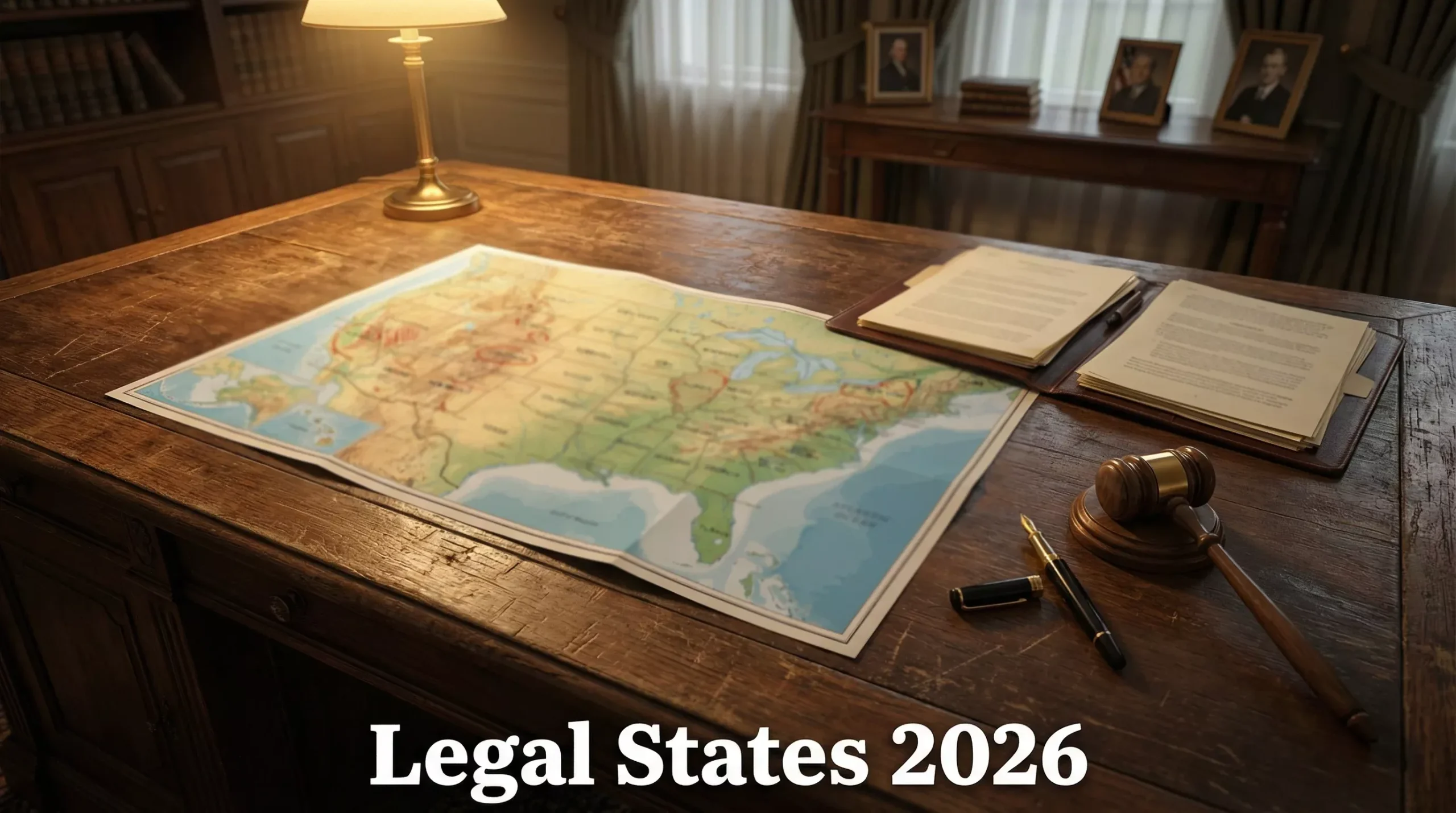
In 2025, the sweepstakes casino legal states map changed faster than at any point in the industry’s history. Six states passed outright bans on dual-currency platforms — not through quiet regulatory memos, but through full legislative votes that signaled a coordinated crackdown. The result was a market that lost roughly a fifth of its US revenue overnight, and a legal landscape in 2026 that looks nothing like it did eighteen months ago.
That wave of bans wasn’t random. According to Gambling Insider, six states enacted legislative prohibitions against sweepstakes casinos in 2025 alone: California, New York, Montana, Connecticut, New Jersey, and Nevada. Each ban targeted the dual-currency model — the mechanism that lets platforms offer casino-style games through Gold Coin purchases bundled with free Sweeps Coins. Before 2025, only Washington and Idaho had restricted access. The addition of California and New York to the ban list didn’t just trim the edges; it gutted the two largest consumer markets in the country.
Eilers & Krejcik Gaming responded by slashing their net revenue forecast. The original projection of $4.7 billion for 2025 dropped to $4 billion — a shift from 36% year-over-year growth to just 16%. Their baseline estimate for 2026 predicts another 10% decline, pushing net revenue down to approximately $3.6 billion. For an industry that averaged 60–70% compound annual growth from 2020 to 2024, that’s not a correction. It’s a reversal.
This article breaks down sweepstakes casino legality by state — every ban, every enforcement action, every pending bill — so you know exactly where you can and can’t play in 2026. The data here comes from legislative records, gaming commission filings, and industry analysts, not from operator marketing pages.
Each ban is detailed in states that banned them.
States That Have Fully Banned Sweepstakes Casinos
Eight US states now have full legislative bans prohibiting sweepstakes casinos from operating within their borders. Two of those — Washington and Idaho — predated the 2025 wave, having restricted sweepstakes-style gaming years earlier through existing gambling statutes. The other six arrived in a single calendar year, each one targeting the dual-currency model by name.
Here’s the complete list as of early 2026.
| State | Bill / Statute | Effective Date | Key Trigger |
|---|---|---|---|
| California | AB 831 | 2025 | Tribal gaming coalition lobbying; AG enforcement pressure |
| New York | SB 5935A | 2025 | Commercial casino operator complaints; revenue protection |
| Montana | SB 555 | 2025 | Existing lottery and tavern gaming protections |
| Connecticut | SB 1235 | 2025 | Tribal compact obligations (Mohegan/Mashantucket Pequot) |
| New Jersey | AB 5447 / SB 4282 | 2025 | Atlantic City revenue cannibalization concerns |
| Nevada | Legislative ban | 2025 | Broad existing prohibition on unlicensed gaming |
| Washington | Pre-existing statute | Pre-2025 | Strict online gambling prohibition |
| Idaho | Pre-existing statute | Pre-2025 | Broad gambling restriction; conservative regulatory approach |
California’s ban deserves its own paragraph because of the sheer economic scale. According to iGaming Business, the state accounted for approximately 20% of total US sweepstakes revenue. New York wasn’t far behind — operators reported $762 million in Gold Coin sales there in 2024. Losing both states in the same year is the equivalent of an e-commerce company being banned from selling in the Northeast and the entire West Coast simultaneously.
What made California’s vote remarkable was its unanimity. The state Senate voted 36-0, and the Assembly followed at 79-0. In a legislature that struggles to reach consensus on routine budget items, sweepstakes casinos managed to unite every voting member against them. AB 831 specifically defined and prohibited the dual-currency model — not sweepstakes promotions broadly, but the Gold Coin purchase mechanism that these platforms depend on.
New York’s SB 5935A followed a similar logic but with a different catalyst. The state had just expanded its regulated iGaming framework, and lawmakers viewed sweepstakes platforms as parasitic competitors siphoning revenue from licensed operators who pay state taxes. New Jersey’s ban came from the same playbook — Atlantic City’s online gaming ecosystem had no interest in sharing customers with unregulated platforms that didn’t contribute to the state’s gaming fund.
Connecticut’s ban was driven by tribal compacts. The Mohegan and Mashantucket Pequot tribes, which operate the state’s two casinos and contribute revenue-sharing to the state budget, argued that sweepstakes platforms violated the exclusivity terms of their agreements. SB 1235 passed with broad bipartisan support.
Montana and Nevada round out the list. Montana’s SB 555 reflected the state’s protectiveness of its existing tavern gaming and lottery infrastructure — small operators who saw sweepstakes casinos as unlicensed competition. Nevada, predictably, treated any unlicensed gaming operation as a threat to its core industry. The state’s gaming control apparatus has never tolerated gray-area operators, and sweepstakes casinos were no exception.
If you’re in any of these eight states, the answer is straightforward: sweepstakes casinos are banned. Operators have geo-blocked access, and attempting to use a VPN to circumvent restrictions violates platform terms of service and potentially state law.
Cease-and-Desist Orders and Regulatory Pressure by State
Legislative bans tell only half the story. Across the country, state regulators and attorneys general have taken matters into their own hands — issuing cease-and-desist letters, filing lawsuits, and subpoenaing operator records in states where no formal ban exists yet. These enforcement actions create a de facto prohibition in some jurisdictions, even when the statute books haven’t caught up.
The numbers are staggering. According to iGaming Business, state regulators across the US sent hundreds of cease-and-desist orders to sweepstakes operators in 2025. Louisiana’s Gaming Control Board issued 40 such notices. Arizona and Michigan combined for more than 100. West Virginia’s Attorney General served 47 subpoenas, and more than 20 operators subsequently withdrew from the state voluntarily rather than face legal proceedings.
These enforcement campaigns vary in legal basis, but the pattern is consistent. State gaming commissions argue that the dual-currency model constitutes unlicensed gambling under existing state law. They don’t need new legislation — they’re applying current statutes to a business model that, in their view, has always been illegal. The operators, naturally, disagree. But when you’re a mid-size sweepstakes platform and a state AG serves you with a formal subpoena, the legal bills alone make continued operation uneconomical.
Dan Hartman, Senior Advisor at GMA Consulting and former Director of the Colorado Division of Gaming, captured the regulatory perspective at the NCLGS Conference in December 2025: “The one thing I’ve said all along is you can’t all break in through the backdoor. Companies pay a lot to get licensed and do the things they do in our state.” That sentiment — that sweepstakes operators are freeloading on a system that licensed casinos paid to build — runs through nearly every enforcement action.
The litigation front is equally aggressive. Roughly 50 active lawsuits against sweepstakes platforms were pending across the country as of late 2025, according to CasinoBeats. Mississippi went further than most — Senate Bill 2510 (2025) classified sweepstakes casino operations as a felony, carrying fines up to $100,000. That’s not a regulatory warning. That’s a criminal charge.
The practical effect of this enforcement pressure is a patchwork of access. In states like Louisiana, Arizona, and West Virginia, sweepstakes casinos aren’t technically banned by statute, but most major operators have pulled out anyway. If you’re checking sweepstakes casino legality by state, don’t just look at the law. Look at whether anyone is still willing to operate there.
Some operators have tried to fight back. A handful have challenged cease-and-desist orders in court, arguing that their model doesn’t meet the legal definition of gambling because no purchase is required to play — the Alternative Method of Entry (AMoE) provides free Sweeps Coins. But courts have been skeptical. When 88% of your revenue comes from Gold Coin purchases, the “no purchase necessary” argument starts to sound like a technicality rather than a legitimate business model.
The enforcement map is dynamic. States that sent a few warning letters in 2024 escalated to formal legal action in 2025. States watching from the sidelines are now commissioning their own investigations. If you’re playing in a state that hasn’t banned sweepstakes casinos but has an active enforcement campaign, you should treat it as a warning — not a green light.
The wider context is set out in our free SC casino guide.
Where Sweepstakes Casinos Still Operate Freely
Despite the ban wave, sweepstakes casinos remain accessible in the majority of US states. As of early 2026, roughly 40 or more states have no legislation specifically prohibiting the dual-currency model — which means platforms continue to operate under the same legal theory they’ve relied on since the beginning: sweepstakes promotions are not gambling.
The logic works like this. Under US sweepstakes law, a legitimate promotion requires three conditions: a prize, no purchase necessary to enter, and winners determined by chance (or, in some cases, skill). Sweepstakes casinos satisfy these criteria — at least on paper — by offering an Alternative Method of Entry. You can send a physical letter to receive free Sweeps Coins, which means the “purchase” of Gold Coins is technically optional. Since there’s no mandatory consideration, the argument goes, it’s not gambling. It’s a sweepstakes promotion that happens to look, feel, and function exactly like an online casino.
This “legal by default” principle is what allows sweepstakes casinos to operate in states that haven’t specifically addressed the model. There is no federal license for sweepstakes gaming. No state has created a dedicated regulatory category for it. The platforms exist in a gray zone where state sweepstakes laws — originally designed for magazine subscriptions and fast-food contests — are stretched to cover a $10 billion digital gambling industry.
The Social Gaming Leadership Alliance (SGLA), which represents many sweepstakes operators, has pushed for formal regulation. Their proposal includes a licensing framework, a 6% tax on player purchases, and mandatory responsible gaming requirements. The pitch is that regulation would bring legitimacy, tax revenue, and consumer protections — the same things that legislative bans are supposedly trying to achieve through prohibition.
For players in states without bans, the practical reality is straightforward. You can register, play, and redeem Sweeps Coins for cash prizes without legal risk. But “legal by default” is not the same as “regulated.” There’s no state agency reviewing the platform’s RNG fairness. No independent auditor verifying payout rates. No state-backed dispute resolution process if something goes wrong. You’re playing on platforms that operate in a regulatory vacuum — and that vacuum could close at any time.
Several states deserve a closer look because of their ambiguous status. Michigan, for instance, hasn’t passed a ban, but its gaming commission has issued cease-and-desist orders that forced multiple operators out. Ohio’s gambling commission has investigated several platforms without taking formal action. Illinois, Pennsylvania, and Florida all have active gaming lobbies that have publicly opposed sweepstakes casinos — but none have passed legislation yet. In these states, sweepstakes casino legality by state is a moving target. What’s legal today might not be legal tomorrow.
Bills on the Horizon — States Likely to Act Next
The 2025 ban wave didn’t end with the sixth state. It set a template that other legislatures are now following. Several states have pending bills or active committee reviews targeting sweepstakes casinos, and the pattern of which states move first is becoming predictable.
Florida is the biggest domino still standing. According to iGaming Business, sweepstakes operators generated more than $1 billion in Gold Coin purchases from Florida players in 2024, representing 8.5% of total US sweepstakes revenue. The Seminole Tribe, which holds an exclusive gaming compact with the state, has made it clear that unregulated sweepstakes platforms violate their agreement. The SGLA attempted to preempt a ban by proposing a 6% tax on player purchases, which would have generated an estimated $63 million annually for the state. So far, Florida hasn’t taken the deal — but it hasn’t passed a ban, either. The 2026 legislative session will be decisive.
Indiana and Maine have also introduced bills targeting the dual-currency model. Indiana’s approach mirrors the pattern seen in other states with established commercial casinos: protect the licensed operators who pay taxes and licensing fees. Maine’s bill is less about protecting incumbents and more about consumer protection — legislators there have raised concerns about the lack of responsible gaming tools on sweepstakes platforms.
The predictive pattern is worth noting. Every state that banned sweepstakes casinos in 2025 shared at least one of these characteristics: a strong commercial casino or tribal gaming presence, an active state gaming commission, or a recent expansion of regulated iGaming. California had tribal compacts worth billions. New York and New Jersey had commercial casino ecosystems. Connecticut had tribal exclusivity agreements. Montana and Nevada had deeply entrenched existing gaming industries. States that match these criteria — Pennsylvania, Illinois, Massachusetts, Ohio — should be considered at elevated risk for future bans.
States without a significant existing gaming industry, by contrast, have shown little urgency to ban sweepstakes casinos. Texas, Georgia, and the Carolinas have no regulated commercial casinos and limited political appetite for gaming legislation of any kind. Sweepstakes platforms are likely to remain accessible in these states for the foreseeable future — not because legislators approve of them, but because there’s no organized industry lobby pushing for a ban.
One caveat applies to every state on every list: this analysis reflects conditions in early 2026. Legislative sessions move quickly when motivated interests align, and a single high-profile lawsuit or consumer complaint can accelerate the timeline from “pending bill” to “signed law” in a matter of months. If you’re relying on sweepstakes casino access in a specific state, monitor your state legislature’s session calendar — and don’t assume that last year’s legal status guarantees this year’s.
How State Bans Reshaped the $10 Billion Market
The financial impact of the 2025 ban wave landed exactly where the numbers said it would — hard. An industry built on uninterrupted expansion suddenly found itself shrinking. The revised forecast from Eilers & Krejcik projects net revenue for 2026 at $3.6 billion, more than a billion dollars below the pre-ban trajectory. That’s not a slowdown in growth. It’s an absolute decline.
The losses were concentrated at the top. California and New York alone accounted for a combined share of revenue that no amount of growth in smaller states could replace. When you ban an online product in states that represent a third of the country’s internet users, you don’t just lose those customers — you lose the network effects, the word-of-mouth, and the social media visibility that drove organic growth.
Operators responded in two distinct ways, and the split reveals a lot about the industry’s future. The largest platforms — Chumba Casino, WOW Vegas, McLuck — absorbed the losses and doubled down on the states that remain open. They increased marketing spend in the South and Midwest, offered more aggressive welcome bonuses, and expanded their game libraries to retain existing players. Their bet is that the remaining 40+ states still represent a massive addressable market.
Smaller operators took a different path. Several exited the US market entirely. Others merged or sold their player databases to larger competitors. The consolidation effect has been significant: in a market that saw 25 new brands launch in 2025, the ban wave ensured that only the well-capitalized ones survived. The era of any startup with a Curaçao license and a basic game library entering the US sweepstakes market is over.
The industry’s lobbying arm has responded by intensifying its push for state-level regulation rather than prohibition. The argument is straightforward: bans eliminate tax revenue that regulation would create. Whether legislators find that persuasive depends on how much pressure they’re getting from existing gaming operators who view sweepstakes platforms as existential threats.
For players, the market impact translates to a few practical changes. First, expect fewer platform options if you’re in a state near the ban line. Operators are pulling out of borderline states preemptively to avoid legal costs. Second, the platforms that remain are investing more in compliance infrastructure — KYC verification, geo-blocking technology, and responsible gaming tools — because they know that demonstrating good behavior is their best argument against future bans. Third, welcome bonuses and promotional offers have gotten more generous as operators compete for a shrinking pool of accessible players. That’s the silver lining of market contraction: the survivors fight harder for your attention.
The sweepstakes casino landscape in 2026 is fundamentally different from what it was two years ago. The legal gray zone hasn’t disappeared, but it’s narrower, more contested, and increasingly defined by state-level decisions rather than federal inaction. The $10 billion market still exists — but its geography has been permanently redrawn.