Ask a sweepstakes casino what its payout rate is and you’ll get one of two answers — both technically true, both potentially misleading. The first: “Our games have 95–97% RTP.” The second: “We paid out 70% of player wagers in prizes last year.” The gap between those numbers isn’t a scam. It’s the single most misunderstood metric in the SC casino space, and understanding why sweepstakes casino RTP works on two levels is essential to setting realistic expectations about how much money you’ll actually keep.
SC casino payout transparency is also uneven. Some platforms host games from studios that publish audited RTP figures. Others run entirely proprietary libraries with no disclosed payout data and no third-party verification. This guide unpacks both levels of payout measurement, explains who audits what (and who doesn’t), and identifies which platforms give you the most visibility into the numbers that matter.
Operator-Level Payout vs Game-Level RTP — Why Both Numbers Are Real
Game-level RTP is the theoretical return built into each individual slot or table game by its developer. When NetEnt designs Starburst with a 96.09% RTP, it means the game is mathematically programmed to return $96.09 for every $100 wagered over an infinite number of spins. This figure is determined by the game’s algorithm, certified by testing labs (in regulated markets), and remains constant regardless of which platform hosts the game. The RTP of a Pragmatic Play slot on Pulsz is the same as that slot on a licensed New Jersey casino site — the math doesn’t change.
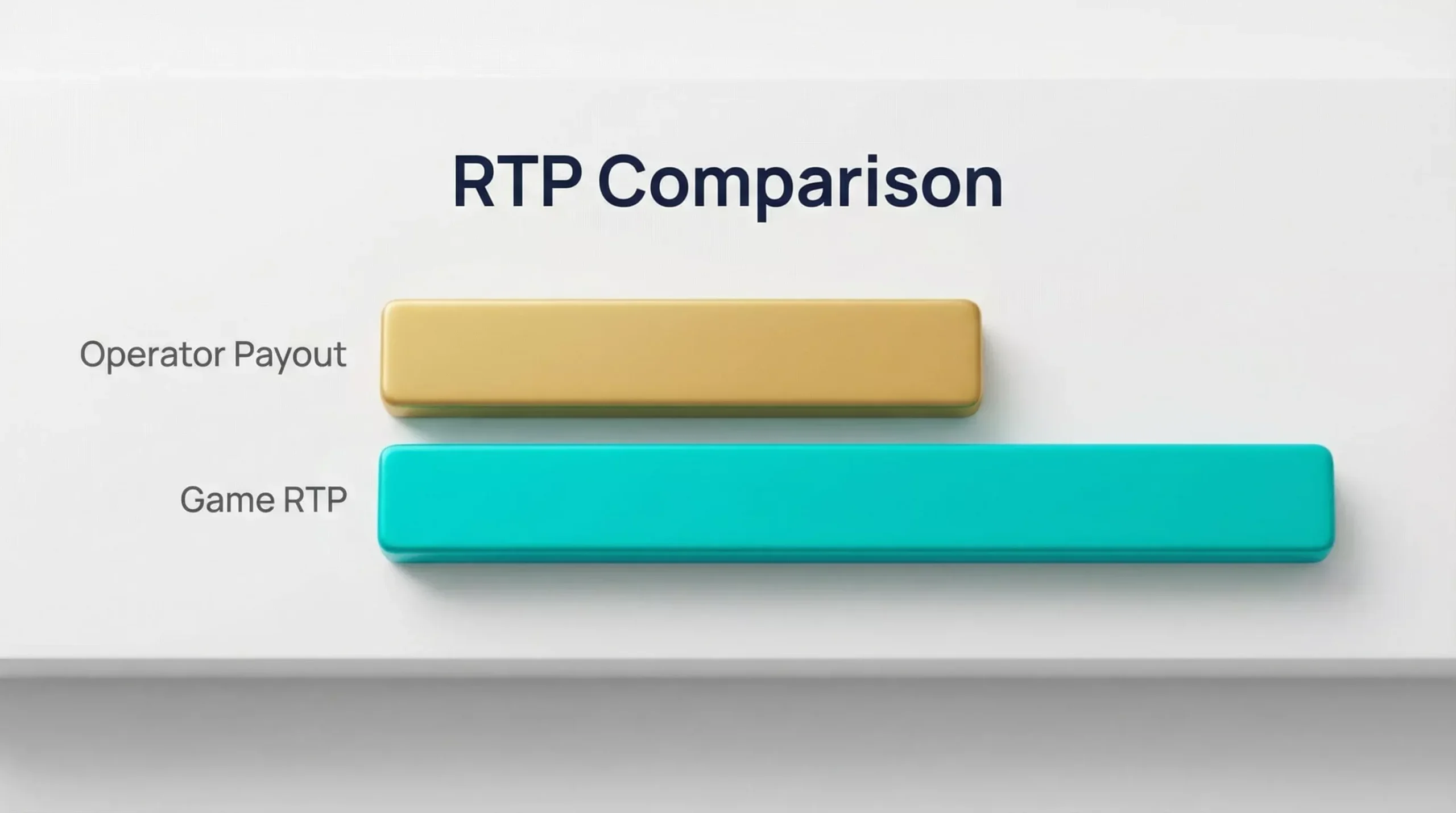
Operator-level payout ratio is the aggregate amount a platform pays out in prizes across all games and all players, relative to total wagering. For sweepstakes casinos, this figure consistently falls between 68% and 72%. That means for every $100 in SC wagered across the entire platform, roughly $68–$72 goes back to players as winnings, and $28–$32 stays with the operator.
The gap between 96% game-level RTP and 70% operator-level payout is not evidence of rigged games. It’s the compound effect of player behavior. When a player bets $10 on a 96% RTP slot, they’ll receive approximately $9.60 back in expected value. But most players don’t stop there — they reinvest their winnings, placing multiple rounds of bets during a single session. Each round of betting subjects the balance to the house edge again. After several rounds of play, the effective return on the original $10 deposit is significantly lower than 96%, because the house edge compounds across every subsequent wager.
A simple example makes this concrete. You start with 100 SC and bet it all on a 96% RTP slot. Statistically, you’ll end up with about 96 SC. Now you bet those 96 SC again: expected result is about 92 SC. Bet again: 88 SC. After ten full cycles of wagering your entire balance, the expected remaining amount is roughly 66 SC — consistent with a 68–70% operator-level payout. The individual game wasn’t rigged. The math of repeated play simply erodes the balance faster than most players intuit.
This distinction is critical for SC casino payout transparency. When an operator says “we pay out 70% in prizes,” they’re telling the truth. When a game developer says “this slot has 96% RTP,” they’re also telling the truth. The numbers describe different things: one measures the theoretical return of a single game over infinite spins, the other measures the actual money flow across an entire platform including the behavioral reality that players reinvest their winnings.
Who Audits Sweepstakes Casino Games — And Who Doesn’t
In regulated iGaming markets — New Jersey, Pennsylvania, Michigan — every casino game must be certified by an independent testing lab before it goes live. Labs like GLI, BMM Testlabs, and eCOGRA verify that the RNG (random number generator) produces genuinely random outcomes and that the game’s actual payout matches its stated RTP. State gaming commissions enforce compliance. This isn’t optional.
Sweepstakes casinos operate under no such obligation. Because the dual-currency model is classified as a promotional sweepstakes rather than gambling, state gaming commissions have no authority to require game audits. No state mandates RNG testing for SC casinos. No regulator reviews payout data. The result is a transparency spectrum that ranges from fully audited third-party games to completely opaque proprietary titles.
The good end of that spectrum includes games from studios like NetEnt, Pragmatic Play, and BGaming. These companies build their games for regulated markets first, where independent certification is required. When those same games appear on SC platforms like Pulsz or WOW Vegas, they run on the same certified builds with the same mathematical models. The RNG hasn’t changed; the regulatory oversight around the platform has. For players who care about verified fairness, choosing a platform that hosts third-party studio games provides an indirect layer of assurance.
The opaque end of the spectrum includes platforms like Chumba Casino, which runs entirely on VGW’s proprietary game engine. VGW doesn’t publish game-level RTPs. There’s no third-party audit certificate available to players. The games work, billions of dollars have been wagered on them, and no credible evidence of systematic rigging has emerged — but the absence of independent verification leaves a trust gap. An AGA survey found that 90% of sweepstakes users consider their activity gambling, yet the majority play on platforms with no mandatory audit structure. That disconnect is one of the central tensions in the SC casino legitimacy debate.
One notable exception: High 5 Games — the studio behind High 5 Casino — also supplies games to the Michigan Gaming Control Board–regulated market, where its titles undergo mandatory MGCB auditing. While High 5 Casino itself isn’t regulated, the fact that the parent studio’s game engine has been independently tested in a licensed jurisdiction provides more assurance than a fully proprietary, never-audited alternative.
Platforms With the Best Documented Payout Rates
Given the audit transparency landscape, “best payout” at an SC casino depends on what you can actually verify versus what you have to take on faith.
| Platform | Game Sources | Published RTP? | Third-Party Audit? | Transparency Rating |
|---|---|---|---|---|
| Pulsz | NetEnt, Pragmatic Play, BGaming, Hacksaw | Yes (via provider docs) | Indirect (provider-level) | High |
| WOW Vegas | Betsoft, BGaming, Pragmatic Play | Yes (via provider docs) | Indirect (provider-level) | High |
| McLuck | Pragmatic Play, BGaming, Relax Gaming | Partial | Indirect | Moderate-High |
| High 5 Casino | High 5 Games (MGCB-audited studio) | Limited | Studio-level (MGCB) | Moderate |
| Chumba Casino | Proprietary (VGW) | No | None | Low |
Pulsz and WOW Vegas lead on payout transparency because their game libraries consist primarily of third-party studio titles with documented, provider-published RTPs. A player on Pulsz can look up the exact RTP of any NetEnt or Pragmatic Play slot on the provider’s website and know that the mathematical model behind the game has been certified in regulated markets. That’s not the same as a platform-level audit — but it’s substantially more information than a player on Chumba has access to.
For players who prioritize knowing exactly what they’re playing, the recommendation is straightforward: choose platforms with deep third-party game libraries. Stick to slots from established studios with published RTPs. And remember that the 68–72% operator-level payout isn’t a ceiling on your personal outcome — it’s an average that includes players who bet aggressively and reinvest every win. Individual results depend on your specific games, bet sizes, session length, and when you choose to stop playing and cash out.