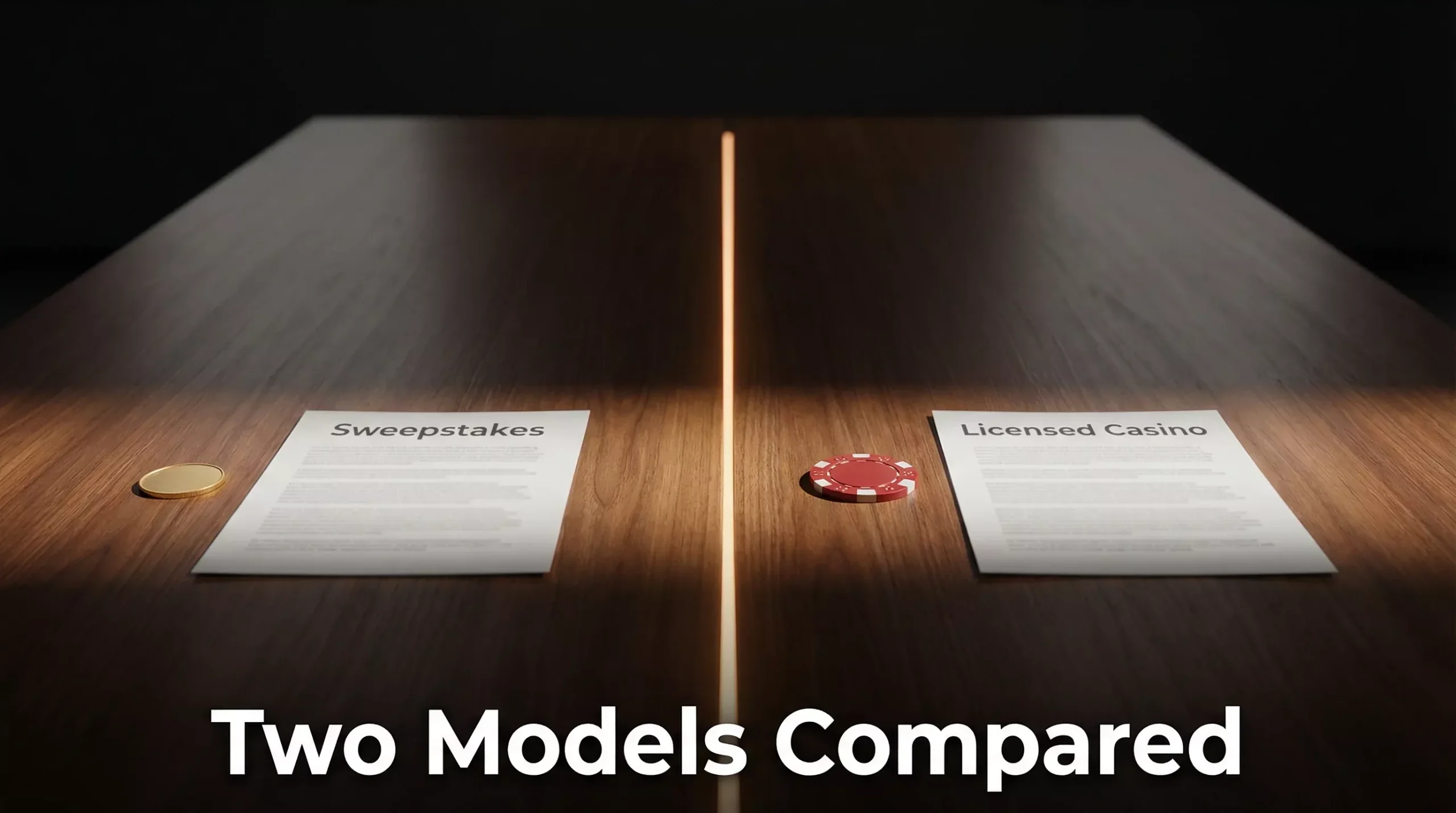
In 2024, something happened that nobody in the regulated gambling industry expected: sweepstakes casinos generated more money than licensed online casinos. The sweepstakes vs real money casino comparison had been theoretical for years — operators dismissed dual-currency platforms as a novelty, a legal curiosity that would fade once regulators caught up. Instead, sweepstakes platforms crossed the $10 billion mark in gross purchases while regulated iGaming reported $8.4 billion in gross gaming revenue. The underdog overtook the incumbent.
The comparison is more than a revenue contest. These are fundamentally different business models operating under entirely different legal frameworks, serving different player populations, in different geographies, with different levels of accountability. Sweepstakes casinos reach 45 or more states through the dual-currency loophole. Regulated iGaming is legal in seven. One sector pays billions in state taxes. The other pays none. One has mandatory consumer protections. The other operates on voluntary good behavior.
This article compares sweepstakes versus regulated iGaming on every dimension that matters to players: revenue and growth, legal availability, consumer protections, payout ratios, and tax treatment. The goal isn’t to declare a winner — these models serve different needs and different markets. The goal is to give you the information to decide which one, or both, fits your situation in 2026.
Revenue Face-Off — $10 Billion vs $8.4 Billion
The top-line numbers tell a dramatic story, but they require context before they mean anything useful. In 2024, sweepstakes casinos generated approximately $10 billion in gross purchases — that’s the total amount players spent on Gold Coin packages, according to research from Eilers & Krejcik Gaming for the SGLA. In the same year, regulated online casinos across the seven licensed US states reported $8.4 billion in gross gaming revenue. On paper, sweepstakes won.
But “gross purchases” and “gross gaming revenue” are not the same metric. Sweepstakes purchases include the full amount players spend on Gold Coin packages before any prizes are paid back. Gross gaming revenue (GGR) in regulated casinos is the amount operators keep after player winnings are deducted — it’s essentially the house’s cut. A fairer comparison would pit sweepstakes net revenue against iGaming GGR. After prize payouts, sweepstakes platforms retained approximately $3.4 billion in net revenue in 2024 — less than half of iGaming’s $8.4 billion GGR. By that measure, regulated casinos are still significantly larger.
The growth trajectories tell a different story. According to a KPMG analysis, the broader social casino market (which includes sweepstakes platforms) reached approximately $7.1 billion in gross revenue in 2024, with analysts forecasting stagnation through 2027 as the market matures and regulatory pressure increases. Sweepstakes casinos grew at a compound annual rate of 60–70% from 2020 to 2024 — a trajectory that made iGaming’s steady 15–20% annual growth look pedestrian by comparison. But the 2025 ban wave changed the calculus. Revised projections from Eilers & Krejcik now anticipate a 10% decline in sweepstakes net revenue for 2026, while iGaming continues to expand as more states legalize.
The revenue comparison also reveals a structural difference. Sweepstakes casinos generate enormous gross numbers because they reach far more players — 55 million Americans annually, compared to the much smaller populations of the seven iGaming states. But they extract less per player than regulated casinos, which operate in concentrated markets with higher average spend. iGaming’s strength is depth; sweepstakes’ strength is breadth.
| Metric | Sweepstakes Casinos | Regulated iGaming |
|---|---|---|
| Gross Revenue / Purchases (2024) | ~$10 billion | $8.4 billion GGR |
| Net Revenue (2024) | ~$3.4 billion | $8.4 billion (GGR = net by definition) |
| Growth Rate (2020–2024 CAGR) | 60–70% | 15–20% |
| 2026 Forecast | ~$3.6 billion net (declining) | Continued expansion as states legalize |
| Geographic Reach | 40+ states | 7 states |
Neither model has “won.” They occupy different positions in the US gambling landscape. Sweepstakes captured the breadth play — massive reach, lower revenue per player, no licensing costs. iGaming captured the depth play — concentrated markets, higher ARPU, regulatory legitimacy. The real question is whether those positions remain stable as more states either ban sweepstakes or legalize iGaming. By 2028, the comparison may look entirely different.
Accessibility — 45+ States vs 7 Licensed Markets
This is the single biggest difference between sweepstakes versus regulated iGaming, and it explains almost everything else — including why sweepstakes platforms grew so fast and why regulated casinos view them as existential threats.
As of early 2026, regulated online casino gaming (iGaming) is legal in seven US states: New Jersey, Pennsylvania, Michigan, West Virginia, Connecticut, Delaware, and Rhode Island. Each of these markets required specific legislation, a licensing process, ongoing regulatory compliance, and revenue-sharing agreements with the state. Getting from “bill introduced” to “first legal bet placed” typically takes one to three years. The regulatory apparatus is extensive by design — it’s meant to ensure consumer protection, prevent fraud, and generate tax revenue.
Sweepstakes casinos bypassed that entire process. By structuring their product as a sweepstakes promotion rather than a gambling operation, they gained access to every state that doesn’t explicitly ban the dual-currency model — which, even after the 2025 ban wave, still includes more than 40 states. No legislation required. No licensing fees. No multi-year regulatory review. The platforms simply launched, geo-blocked the states that banned them, and opened for business everywhere else.
The accessibility gap has profound consequences for player behavior. If you live in New Jersey, you have a genuine choice: play at a regulated online casino with full consumer protections, or play at a sweepstakes casino without them. If you live in Texas, Georgia, or any of the thirty-plus states without legal iGaming, sweepstakes casinos are the only option that looks and feels like an online casino. For millions of Americans, the sweepstakes vs real money casino question is moot — there’s only one option available, and it’s the unregulated one.
This dynamic is exactly what fuels the political tension. Regulated casinos in the seven iGaming states argue that sweepstakes platforms are cannibalizing their potential markets. States that might have legalized iGaming — creating tax revenue and jobs — have less incentive to do so when their residents already have access to casino-style gaming through sweepstakes platforms. Why go through the legislative effort if voters are already being served, albeit by an unregulated alternative?
The SGLA’s counterargument is that sweepstakes casinos fill a vacuum that legislators created by not legalizing iGaming faster. In states where there’s no political appetite for gambling legislation, sweepstakes platforms give consumers something they clearly want — access to casino-style games — without requiring anyone to vote for a gambling bill. Whether you view that as consumer-friendly innovation or regulatory arbitrage depends on your perspective. Either way, the accessibility difference remains the defining feature of the sweepstakes versus regulated iGaming landscape.
The iGaming expansion pipeline adds another variable. Several states are actively considering iGaming legalization — Illinois, Indiana, New York (prior to its sweepstakes ban), and others have introduced or studied bills. Each state that legalizes regulated iGaming simultaneously reduces the addressable market for sweepstakes casinos and increases the competitive pressure. A player in a newly regulated state who can choose between a licensed casino with consumer protections and a sweepstakes platform without them has far less reason to choose the sweepstakes option. The expansion of iGaming and the contraction of sweepstakes may prove to be two sides of the same coin.
Player Protections — Licensed Casino vs Sweepstakes Platform
Consumer protection is where the comparison between sweepstakes and regulated casinos becomes starkest — and where the stakes are highest for individual players. The difference isn’t just regulatory. It’s structural. Licensed casinos are built on a foundation of mandatory accountability. Sweepstakes casinos are built on voluntary good behavior.
In a regulated market, the state gaming commission sets the rules and enforces them. Operators must verify player identity before allowing real-money play. Games must be tested by independent labs. Self-exclusion programs must be offered, and operators must respect them across platforms. Player funds must be segregated from operating funds. Advertising must meet content standards. And if an operator violates any of these requirements, the gaming commission can fine them, suspend their license, or shut them down.
Sweepstakes casinos have none of these mandates. Some platforms voluntarily implement some of these protections — KYC verification, basic self-exclusion options, links to problem gambling resources. But “voluntarily” means there’s no external verification that the tools work as described, no penalty for removing them, and no consistent standard across the industry. One platform might offer robust self-exclusion; the next might offer nothing.
The scale of the unregulated market underscores the concern. According to the AGA’s analysis reported by Yogonet, unregulated operators — including sweepstakes casinos, offshore sites, and illegal sportsbooks — handled approximately $109 billion in wagers in 2024, representing an estimated $17.3 billion in lost revenue for the regulated industry. Sweepstakes casinos are the largest single category within that unregulated market, and they’re the most visible to consumers because of their aggressive marketing.
Tres York of the AGA offered a pointed assessment of the business model in 2025, calling it “essentially a too-clever-by-half attempt to offer online casino gateways to the public.” The characterization reflects the regulated industry’s view that sweepstakes casinos are gambling operations that have found a legal technicality to avoid the costs and obligations of a gambling license — while still competing for the same customers.
| Protection | Regulated iGaming | Sweepstakes Casinos |
|---|---|---|
| State gaming license | Required | Not required |
| Independent RNG audit | Mandatory, state-enforced | Voluntary, rare |
| Self-exclusion programs | Mandatory, cross-platform | Voluntary, platform-specific |
| Deposit / purchase limits | Mandatory | Voluntary or absent |
| Consumer complaint process | State gaming commission | Operator’s customer support |
| Player fund segregation | Required by law | Not required |
| Advertising oversight | State-regulated | No oversight |
The protection gap matters most at the margins — when things go wrong. A regulated casino that freezes your account must explain why and give you a path to appeal through the state gaming commission. A sweepstakes casino can freeze your account because its terms of service say it can. The difference isn’t theoretical. It’s the difference between playing on a platform that answers to a state authority and playing on one that answers only to itself.
There’s a less visible but equally important distinction in how the two models handle player funds. Regulated casinos are required to maintain player balances in segregated accounts, separate from the company’s operating funds. If the operator goes bankrupt, your balance is protected. Sweepstakes casinos have no such requirement. Your Sweeps Coin balance is a liability on the operator’s books, not a protected deposit. If a sweepstakes platform shuts down — whether because of a ban, a lawsuit, or simple insolvency — there’s no mechanism to guarantee you’ll recover your unredeemed balance. In a market where consolidation is actively underway and smaller operators are exiting, that’s not a hypothetical risk.
Payout Ratios and Tax Treatment Side by Side
Players care about two things above all else: how much they can win and how much they keep after taxes. On both counts, the sweepstakes vs real money casino comparison reveals meaningful differences that most guides overlook.
Start with payouts. At the game level, both models offer similar return-to-player percentages. A slot game at a regulated online casino might advertise a 96% RTP; a comparable slot at a sweepstakes casino might show 95%. The difference is negligible in individual sessions. But at the operator level, the story diverges sharply. Regulated online casinos typically retain 8–15% of total wagers as gross gaming revenue, meaning players get back 85–92% of what they bet over time. Sweepstakes casinos retain 28–32% at the operator level, returning only 68–72% to players in aggregate.
The gap exists because of how the money flows. In a regulated casino, a player deposits $100, bets it, and the casino keeps its margin on those bets. In a sweepstakes casino, a player buys a $100 Gold Coin package, receives bonus Sweeps Coins, plays through them multiple times (because playthrough requirements mandate it), and then redeems whatever remains. The multiple play-through cycles compress the effective payout, even though each individual game maintains a high RTP. The structure guarantees the operator keeps a larger slice.
Tax treatment is the other divide. Regulated casino winnings are classified as gambling income, reported on a W-2G form, and subject to the gambling loss deduction rules on Schedule A. You can offset your winnings with documented losses, dollar for dollar, up to 90% of those losses under the OBBBA’s new cap. Sweepstakes casino winnings are classified as Other Income, reported on a 1099-MISC, and the deduction pathway is murkier. Gold Coin purchases are not considered wagers by the IRS, so they’re not deductible as gambling losses. You’re taxed on gross redemptions with no recognized offset for what you spent.
The state tax angle amplifies the disparity. Commercial casinos paid $18.09 billion in state gaming taxes in 2025. Sweepstakes casinos paid nothing. For players, this matters indirectly: every dollar of state gaming tax that regulated casinos pay funds public services, infrastructure, and — in many states — problem gambling programs. When you play at a regulated casino, a portion of the house edge flows back to the state. When you play at a sweepstakes casino, the house edge stays with the operator. The broader societal impact of your play is measurably different depending on which model you choose.
| Metric | Regulated iGaming | Sweepstakes Casinos |
|---|---|---|
| Operator-level payout | 85–92% | 68–72% |
| Game-level RTP | 94–99% | 94–99% |
| Tax form | W-2G | 1099-MISC |
| Loss deduction | 90% of losses deductible (Schedule A) | GC purchases not deductible |
| State gaming taxes paid by operator | $18.09 billion (2025, industry total) | $0 |
The payout and tax comparison favors regulated casinos on every metric except accessibility. If you have access to both options, the math is clear: you keep more of your winnings, lose less to the house edge, and have a more straightforward tax situation at a licensed casino. The only advantage sweepstakes casinos hold in this dimension is that they exist in states where the alternative doesn’t.
Which Model Fits Your Situation
The sweepstakes vs real money casino choice depends on three factors: where you live, what you prioritize, and how much you plan to spend.
If you live in one of the seven iGaming states — New Jersey, Pennsylvania, Michigan, West Virginia, Connecticut, Delaware, or Rhode Island — you have a genuine choice. And in that choice, regulated casinos hold every advantage except one: some players prefer the sweepstakes model because the free-to-play entry point feels lower-risk. The perception that you’re “playing for free” and only spending on Gold Coin packages makes the experience feel different from depositing cash into a gambling account, even though the financial mechanics are similar. If that psychological distinction matters to you, sweepstakes casinos offer it. If you care about consumer protections, better payouts, and a clearer tax picture, regulated iGaming is the stronger option.
If you live in any of the 40+ states where iGaming is not legal, sweepstakes casinos are the only option that resembles an online casino. There’s no regulated alternative to compare against. In that situation, the relevant question isn’t “sweepstakes or regulated” — it’s “sweepstakes or nothing.” Make that decision with clear eyes. Understand the protection gaps, the payout structure, the tax implications, and the lack of external oversight. If you choose to play, set your own limits and treat Gold Coin purchases as entertainment spending with no guaranteed return.
Budget matters too. Casual players who spend less than $50 a month and view it as entertainment will find sweepstakes casinos adequate for their needs. The protection gaps are less impactful when the stakes are low. Players who spend hundreds or thousands per month face a different risk profile. At higher spending levels, the operator-level payout gap (68–72% vs 85–92%) compounds significantly, the tax treatment becomes a real financial factor, and the absence of regulatory recourse becomes a more serious exposure. If your annual spending exceeds a few thousand dollars, the sweepstakes versus regulated iGaming comparison should weigh heavily toward the regulated option — if it’s available to you.
Neither model is inherently “better.” Both are products of the US regulatory environment — one created by legislation, the other by the absence of it. The game selection and experience quality have converged — many sweepstakes casinos now offer titles from the same providers that supply regulated platforms, including Pragmatic Play, NetEnt, and BGaming. The games themselves feel similar. What differs is everything around them: the protections, the payouts, the tax treatment, and the accountability. Those differences compound over time, especially at higher spending levels. The best you can do is understand the tradeoffs and choose accordingly.